Tools
DaeOne: One Interface to Run Your Entire Website
Website ownership is fragmented. DaeOne fixes that with a single AI-powered dashboard that handles everything from leads to SEO.
- Published
- 5 Sep 2026
- Reading
- 5 min
- Class
- tools
half-life 90dfrom 5 Sep 2026
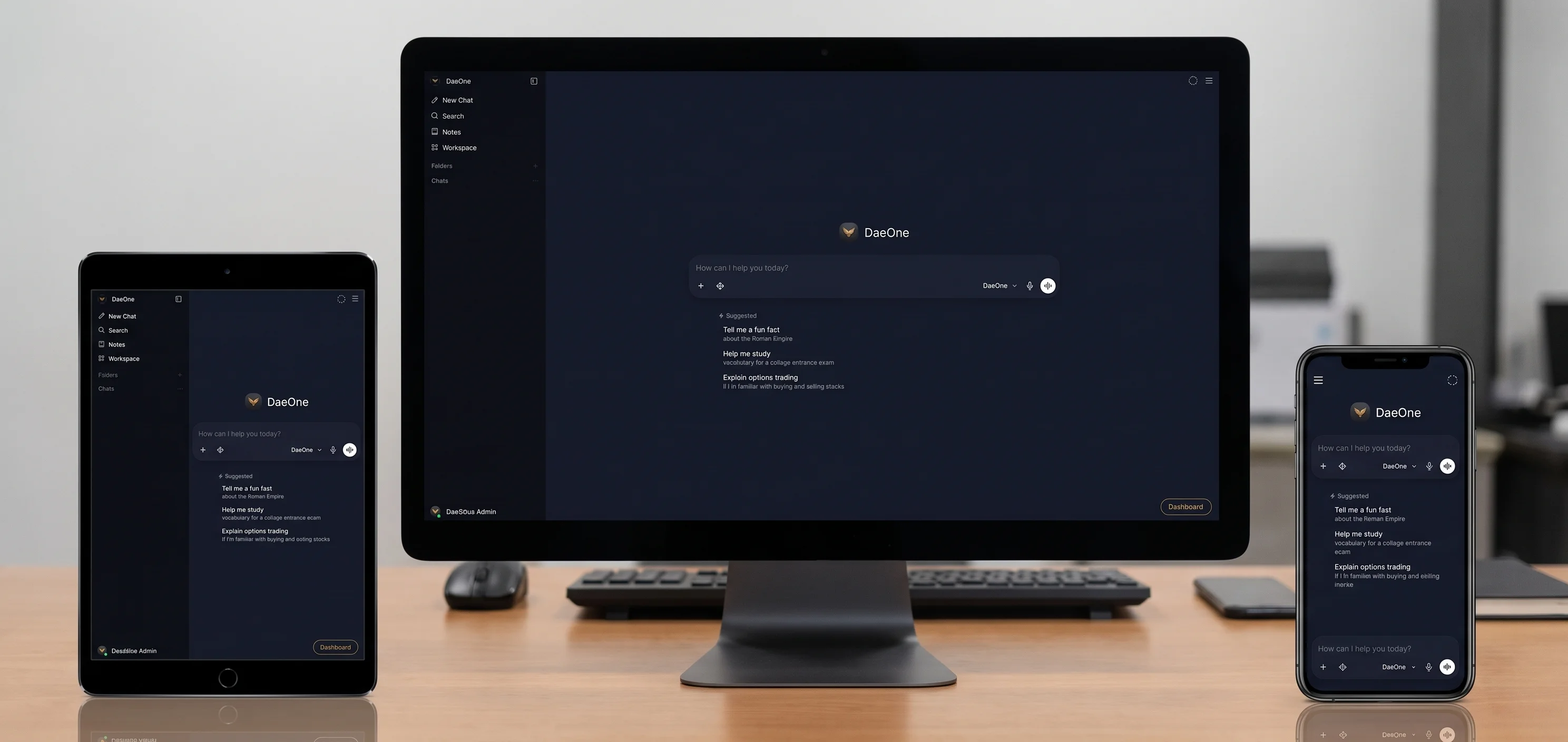
If you own a website, you already know the drill. Analytics live in one tab, email marketing in another. SEO tools are a separate subscription. Support tickets come through a different platform entirely. Your CMS does content, but your CRM does contacts, and neither talks to the other without a Zapier bridge that breaks every other month.
This is the normal state of affairs for most website owners — and it is quietly terrible. Every tool adds a login, a dashboard, a learning curve, and a monthly invoice. The overhead of managing the tooling often exceeds the overhead of managing the business.
DaeOne exists to collapse all of that into a single interface.
The fragmentation tax
Consider what a typical small business website actually needs to function as a business tool rather than a digital brochure:
- Analytics — knowing who visits, what they look at, and where they drop off.
- Lead capture — forms, chat widgets, enquiry tracking.
- Email — transactional confirmations, newsletters, drip campaigns.
- SEO monitoring — keyword rankings, page health, content gaps.
- Support — ticket management, FAQ handling, response SLAs.
- Task management — content updates, design changes, bug fixes.
Each of these typically requires its own tool or platform. That means six logins, six dashboards, six billing cycles, and six sets of context you have to mentally stitch together. The switching cost is not just time — it is attention. Every context switch degrades the quality of the decision you make next.
For a solo operator or a small team, this fragmentation tax is proportionally enormous. You spend more time orchestrating tools than acting on what they tell you.
What DaeOne actually does
DaeOne is a unified web management interface. It brings analytics, leads, email, SEO, support, and task management into a single dashboard — and then layers AI on top so you can interact with all of it through natural conversation.
The dashboard gives you the numbers at a glance: visitor trends, open leads, pending tasks, support queue depth, email performance. But the real shift is the chat interface. Instead of navigating menus and filtering tables, you ask questions.
"Which landing pages had the highest bounce rate last month?" gets you an answer, not a report you have to interpret. "Draft a follow-up email for the three leads that came in this week" produces a draft you can review and send. "What SEO improvements should I prioritise?" generates a ranked list based on your actual traffic data.
This is not a chatbot bolted onto a dashboard. The AI has access to your live data — analytics, lead pipeline, email metrics, task queue — and can act on it. It can create tasks, draft emails, flag anomalies, and surface insights you would otherwise miss because you did not think to look in that particular report.
From passive website to active business tool
Most websites are passive. They sit there, serving pages, collecting dust in Google Analytics. The owner checks in occasionally, maybe updates a blog post, maybe notices a broken link six weeks after it broke.
DaeOne changes the relationship between you and your website. With continuous monitoring and AI-driven analysis, the website becomes an active participant in your business operations. Leads do not just arrive — they get flagged, categorised, and queued for follow-up. SEO issues do not sit unnoticed — they surface as actionable tasks. Support queries do not pile up in an inbox — they get triaged and, where appropriate, answered automatically.
The practical effect is that you spend less time checking dashboards and more time making decisions. The system monitors continuously and comes to you when something needs attention, rather than waiting for you to remember to log in.
How the AI layer works
DaeOne uses large language models to bridge the gap between raw data and human decision-making. It translates natural language queries into data lookups, interprets trends, and generates contextual responses — email drafts, SEO recommendations, task descriptions — that are grounded in your actual site data rather than generic templates.
For technical readers: the AI is not summarising a static knowledge base. It has real-time access to your analytics pipeline, contact database, and task queue. It can query across these systems to answer compound questions like "Show me the leads from organic search who visited the pricing page but did not convert, and draft a re-engagement email for each." That kind of cross-system query normally requires a BI tool and an email platform working in concert. Here it is one conversation.
The system also learns your patterns over time. If you consistently ask for weekly traffic summaries, it will start surfacing them proactively. If you always follow up on certain lead types with a specific email template, it will learn that and suggest it next time.
Who this is for
DaeOne is aimed at anyone who owns or manages a website but does not have a dedicated marketing team, SEO specialist, and support department on staff. Freelancers, small businesses, agencies managing client sites — anyone who currently juggles multiple tools to do the basics.
If your current setup involves Google Analytics, Mailchimp, a separate CRM, a support desk, and a task manager — and you have ever wished you could just ask someone "how is the site doing?" and get a straight answer — DaeOne is built for that.
Get started with AI hosting
DaeOne is available as part of Daedalus Design's AI hosting packages. These pair managed hosting with a DaeOne instance configured for your site, giving you the full dashboard and AI chat experience without having to set anything up yourself. You can view the available packages and pricing at daedalusdesign.co.uk/ai-hosting.
For teams that have outgrown the patchwork approach to website management, DaeOne offers a genuinely different model: one interface, one AI, one clear picture of what your website is doing for your business.